
I got one of my Ellipsoids powder coated in the proper Deutsch Silver that these wheels came with as OEM.
The finish was 'ok'
The expected orange peel surface lacquer was clearly evident all over the alloy, a feature mostly caused by a lumpy base coat which is what goes on first by electrostatic charge attraction (or something)... this base coat could be flattened before the metallic coat goes on, and then the lacquer would likely go on much smoother too, but that would add extra cost.
Anyway, there were a few other defects, like pin marks in the base coat, which you couldn't feel in the lacquer. These are noticeable from a metre away in flat but bright conditions outside. There were around 10 of these on the wheel, which was a bit disappointing.
There were also some points where the base coat is clearly a bit thinner and so has a very orange peel texture to it where it's not smoothed out as the build gets deeper. These I can't do much about, but the lacquer can be smoothed.
Anyway, I started with 2000 wet and dry, at first the texture really jumps out, as the top of the peaks go matte, and the deepest points stay shiny... this takes a long time to work down, attacking, then drying, until the deepest spots are starting to go matte too. At that stage I worked with 2500, then 3000 at the end for a while longer, really getting lots of water on there.
I then used Megs Ultimate Compound by hand, several passes really boost the finish. So far I have used two, and it got twice as glossy. I feel with more passes (really need a dremel or something for these small areas with a tiny mop on the end) the gloss will really jump out!
Here is a picture of the general colour/finish of the wheel, and then a few before/afters.
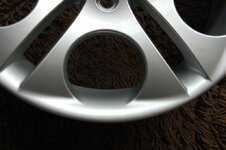
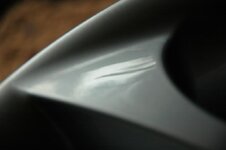
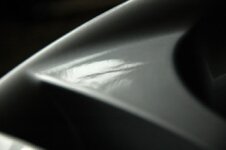
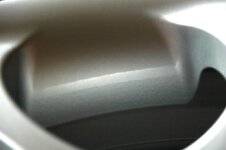
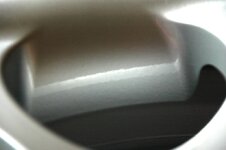
I will take more pictures when I re-work more of the alloy (ie, when wet sanding)... this was more an experiment to see how deep the lacquer was. It's clearly thick enough to be smoothed almost totally, but I'm not sure how much is left. It may well be that 25% of the coat has the lumps and the rest is nice, or it may well be that I've taken 75% away to get a smooth surface. It would be interesting to keep working on the back of a spoke and see how long it takes to work through.
All fun, very hard work. Now I'm not sure whether to get my other wheels done or not. The defects kinda bug me, but £60 per wheel is pretty cheap (would be £90 to get them done with wet paints/flatted properly, so might just stump up the extra £120 and do that and be 100% happy with them)
So, powder can be cut back smooth, but can you be arsed? If the process actually included a flatting stage after the base then they would be lots better (the coater said they could do that, but it'd push the price to £90 anyway, and I'd rather just got wet painted at that price!)
Dave
The finish was 'ok'
The expected orange peel surface lacquer was clearly evident all over the alloy, a feature mostly caused by a lumpy base coat which is what goes on first by electrostatic charge attraction (or something)... this base coat could be flattened before the metallic coat goes on, and then the lacquer would likely go on much smoother too, but that would add extra cost.
Anyway, there were a few other defects, like pin marks in the base coat, which you couldn't feel in the lacquer. These are noticeable from a metre away in flat but bright conditions outside. There were around 10 of these on the wheel, which was a bit disappointing.
There were also some points where the base coat is clearly a bit thinner and so has a very orange peel texture to it where it's not smoothed out as the build gets deeper. These I can't do much about, but the lacquer can be smoothed.
Anyway, I started with 2000 wet and dry, at first the texture really jumps out, as the top of the peaks go matte, and the deepest points stay shiny... this takes a long time to work down, attacking, then drying, until the deepest spots are starting to go matte too. At that stage I worked with 2500, then 3000 at the end for a while longer, really getting lots of water on there.
I then used Megs Ultimate Compound by hand, several passes really boost the finish. So far I have used two, and it got twice as glossy. I feel with more passes (really need a dremel or something for these small areas with a tiny mop on the end) the gloss will really jump out!
Here is a picture of the general colour/finish of the wheel, and then a few before/afters.
I will take more pictures when I re-work more of the alloy (ie, when wet sanding)... this was more an experiment to see how deep the lacquer was. It's clearly thick enough to be smoothed almost totally, but I'm not sure how much is left. It may well be that 25% of the coat has the lumps and the rest is nice, or it may well be that I've taken 75% away to get a smooth surface. It would be interesting to keep working on the back of a spoke and see how long it takes to work through.
All fun, very hard work. Now I'm not sure whether to get my other wheels done or not. The defects kinda bug me, but £60 per wheel is pretty cheap (would be £90 to get them done with wet paints/flatted properly, so might just stump up the extra £120 and do that and be 100% happy with them)
So, powder can be cut back smooth, but can you be arsed? If the process actually included a flatting stage after the base then they would be lots better (the coater said they could do that, but it'd push the price to £90 anyway, and I'd rather just got wet painted at that price!)
Dave


