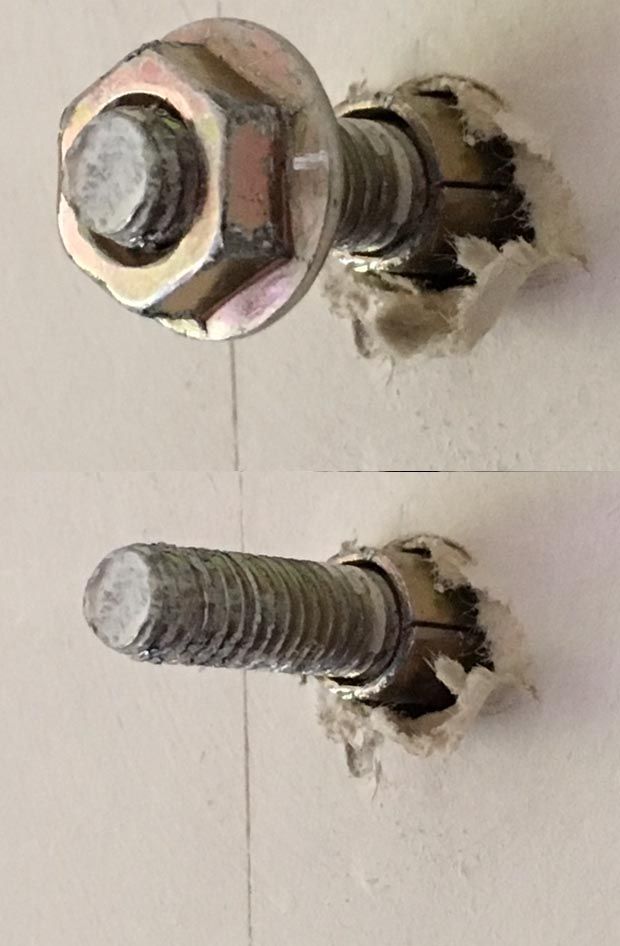
Wall fixing identification.

exdos

Veteran
My daughter has tasked me with removing some wall fixings from a false wall which were used to anchor a bracket for a large flat-screen TV in a house she's recently bought as per the photos below. To me, these look a bit like through bolts which are used for solid walls and floors. Can anyone identify the type of fitting and suggest the best way to remove these fittings without damaging the plasterboard or making the holes bigger, because I'll get the blame if I make a mess! :oops: Thanks for any help in advance. :thumbsup:

wall%20fittings_zpsca2rlg0y.jpg
 
If you grip the sleeve with a pair of mole grips or pump pliers, not too tight, and tap the bolt back into the hole with a hammer it should push back allowing the sleeve to close back up and allowing you to pull the lot back out.
 
john-e89 said:
If you grip the sleeve with a pair of mole grips or pump pliers, not too tight, and tap the bolt back into the hole with a hammer it should push back allowing the sleeve to close back up and allowing you to pull the lot back out.


What John said basically as you have to try and get the casing that expanded outwards, gripping the wall, to reduce again as you try to remove it. The tapered nut at the end of the bolt gets pulled up into the casing as you tighten it from the front, forcing it apart, until this is tapped back out of the casing, you'll not be able to remove it without making the hole considerably bigger.

Just think of your old handlebars on your bike when you were a kid, to raise and lower them you'd have to undo the bolt going thru the stem, tap it to free it then adjust the height of the bars before retightening them.

bWDQNj8l.png
 
It looks a Rawlbolt as John-e89 says, which is only used for fixing to a solid wall or floor and totally unacceptable for what looks like a plasterboard stud wall. If its not a Rawlbolt it could be the type of fixing that when you tighten the bolt it collapses an internal part tha pulls up tight against the back of the plasterboard.
Hopefully you can reposition the bracket and use proper stud wall fixings and there are too many of these to mention. Look at Screwfix or Toolstation for example and select a size/type that is suitable for the holes in the TV bracket. They look like 8 or 10mm from the photos.
If you can't reposition the bracket, it becomes more difficult and maybe look at fixing a small board over the Rawlbolt with say 4 plasterboard fixings and you could possibly use the existing Rawlbolt if it is still secure.
All is not lost there's always a way round the problem. Mr Wilks I understand is a builder by trade and he may well have some better solution.
Best of luck.
 
I agree it looks like a Rawlbolt and I've used them several time in the past, but I've never seen anything like that as a stud-wall fastener.

The bit that puzzles me is this: since the nut/washer can be removed from the fitting, leaving the threaded bolt in place, how was the fitting inserted so that the thread could be turned to tighten the captive nut in the fastener on the back of the wall without damaging the thread to a accept the nut/washer? Would the fitting instructions suggest wrapping a rag around the thread and then use mole grips?
 
exdos said:
I agree it looks like a Rawlbolt and I've used them several time in the past, but I've never seen anything like that as a stud-wall fastener.

The bit that puzzles me is this: since the nut/washer can be removed from the fitting, leaving the threaded bolt in place, how was the fitting inserted so that the thread could be turned to tighten the captive nut in the fastener on the back of the wall without damaging the thread to a accept the nut/washer? Would the fitting instructions suggest wrapping a rag around the thread and then use mole grips?

It's a through bolt Exdos, you drill a hole the same size as the sleeve then tap the assembly in thus leaving you with a thread sticking out as a wheel bolt for eg, the 'bulb' at the back of the thread pulls forward as you tighten the nut splaying the sleeve thus gripping the drill hole. You use them to mount things like the tv bracket etc, the rawlbolt like in nb67's pic have a hole drilled slightly bigger than the sleeve, you then insert the assembly flush with the wall, floor, take the bolt out, mount your plate etc, then screw the bolt into the sleeve in the drilled hole. Same principle just different ways of doing things. The one you show cannot be in a stud wall, plaster board would'nt hold a bolt like that unless it's been drilled into a stud, in which case you would have just used a woodscrew, you may have dot and dabbed plaster boards or studded out boards, either will have them spaced away from the back wall giving the impression of a stud wall.

Don't be afraid to give it a fair clout if needed, there may well be debris at the back of the bolt that needs crushing, pushing back out of the way, as long as you're gripping the sleeve you can get hefty with it if needs be.
 
Back
Top Bottom