swanicyouth
Member
https://youtu.be/HR91NgnUhiY
I made a video describing the procedure I used to reinstall the vanos unit after rebuilding it, replacing upper chain guide, & replacing the oil disk hub with a drilled hole Besian one. There are tons of DIYs out there showin you how to do this on e46 M3 turning nuts & bolts, but I could only find a few posts for Z4 M.
If you haven’t researched or tackled this job yet, the difference between e46M & e85M is the vanos unit can not be reinstalled on the vehicle with the splined shafts attached to it on e85 due to lack of clearance with the radiator support / bulkhead. You have to install the splined shafts in the car, push the Vanos pistons forward, & then attatch them to the splined shafts in the car.
You then have to then bottom out the pistons with the whole unit hanging from the longer solenoid bolts in situ using picks / screwdriver / fingers etc… This method proved unreliable to me, as I would have swore I had both pistons bottomed out. Instead of just keeping my fingers crossed, I removed the piston caps & found them to be close, but off by ~ 1mm. I know this, because I previously measured the positions of the pistons in their bore while completely bottomed out against the stops on vanos piston caps while the whole unit was on the bench.
So, I ended up coming up with a way of doing it that allows you to be 100% sure the pistons are bottomed out. If you do it this way & check the cams are not moving while you slowly tighten the vanos unit to the head by checking the pins go through each side of the BMW brand tool cam bridge you should should only need to time the engine / install the vanos one time, instead of trying it multiple times because the cams moved a hair. You don’t have to jack up the engine or similar. You can leave the vanos oil feed tube in the head or in the vanos - it doesn’t matter. There is enough clearance to to it either way, especially with piston caps off during installation.
This is because you will be installing the vanos on the vehicle without the piston caps, and the pistons will slide back slightly farther in there bore (almost hanging out) & they are moving back instead of already being bottomed out & putting force on the cams (making them want to move / twist) as you tighten the vanos unit slowly to the car.
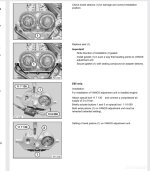
BMW TIS tells you to specifically use these 2 speciality tools specifically for Z4 M to do this if the engine is in the car. The cost of the 2 tools is about $500 US. I’ve seen a post here where someone even built their own solenoid switching box. The way the specialty tools work is the switching box energizes the vanos solenoids so shop air can move them back & forth. The shop air is mimicking engine oil the car would normally use to move the pistons & the switching box basically has 2 commands - pistons full forward or back. It looks like you may be able to even mimick the shop air to vanos high pressure line tool with a blow gun with a rubber tip, but I didn’t try this - as I didn’t have access to the switching box. I believe TIS also has you use these tools to get the initial oil pressure / residue out of the vanos unit, but you can accomplish this per Besian procedure by simply removing the solenoid/solenoid manifold & turning the engine / rocking the cams.
I’m sure there are others out there, but I’ve only seen one mention of someone actually using these tools to do vanos work on Z4 M & that was by Reddish (Motorsports?) - a BMW repair specialist I believe is in the UK or Ireland who seems to really be top notch. Honestly, if I was going to be doing multiple Z4 M vanos jobs as a professional shop, I’d probably invest in these tools as well. But for DIY one & done you can do it without them.
In doing this, I purchased a BMW brand cam bridge & an aftermarket cam bridge (chrome / red you often see). They both were brand new. By checking multiple times multiple ways, I found the variation between the 2 tools to exceed the spec BMW says the bridge can be off the head. In other words, you could be in perfect time with the aftermarket tool & put the BMW tool on the head & in order to get one of the pins in, the tool would rise > 1/2 mm off the head. You have to make up your own mind if this is significant enought to cause an issue or not. My guess would be most of the time it doesn’t cause an issue, but rarely it could & there is no way to predict if that rare case is you.
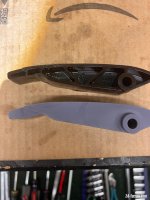
The only issue I had during this job was getting the cam sprockets back on - my chain was tight. I did replace the upper chain guide with Besian chain guide, I don’t known if the Besian guide is a bit “thicker” or not & maybe contributed to this.
Also you want to be real cautious re-installing the timing chain tensioner, as it’s screwed in under tension & you have to compress it somewhat to get the threads started. You want to make sure it is not going in cross threaded - for some reason that’s exactly what mine wanted to do. A 32mm socket that holds the thread of the chain tensioner proud of the socket lip will help. I didn’t have this, my tensioner sunk all the way into my socket, leaving me to try to get it started by hand, which likely is why it wanted to cross thread. I ended up shoving paper towels in the bottom of the socket & I was able to get it in straight.
If I was doing this on an e46 I would follow Fat Boys garage YT videos & do it like them. Also, on my car the piston seals where smooth as new. I did replace them because I bought them, but it was not necessary. I also replaced the 12 cam sprocket bolts & hub bolts, using blue Loctite on the former. I used a new BMW solenoid sealing plate & an Ehlring (BMW OEM) vanos to head gasket.
Prior to this I replaced the factory vanos rigid high pressure line with a flexible one from BimmerWorld. This turned out to be a headache, as the banjo bolt is 2mm thinner on the BW line, making it so there were not enough threads in the bolt to tighten either end down to seal. Luckily, I removed the oil accumulator from the car to install the banjo bolt - as it would have sprayed oil everywhere.
How is this possible? I must have done something wrong? They’ve had to sell thousands of these lines? Well, it turns out BimmerWorld mentions in the ad for the line 1% of the banjo bolts can be an issue like this. I’m going to guess 98% of the lines went on e46 M3s. Production of those ended in 2006. BimmerWorld theorized the problem banjo bolts are aftermarket. I bought this car new in 2008 - nobody has touched the engine but me. Its never been to any shop except for tires. These bolts are factory & have not been touched I can 100% assure you, unless someone snuck in my garage one night & swapped out my banjo bolts without my knowledge.
I let BimmerWorld known of the issue with photos & they 100% did me right. They took the issue seriously, sold me new bolts, & then refunded me the entire amount I paid for the line (I didn’t ask for a refund). I’ve delt with them before & they are the best of the BMW parts places in the USA IMHO. They also tend to be cheaper & if you live on the east coast USA you get your stuff faster. I have zero affiliation with anyone in the auto parts biz - but I recommend dealing with them, they stand behind stuff.
They also told me they are looking into re-engineering the part, as my concern is that if someone didn’t notice they would either have a major oil leak or stripped threads on an attempt to tighten the banjo bolts down in the vanos or vanos accumulator. My car is an ‘08 Z4 M & the theory is BMW got a different bolt supplier at one point after e46 M3 ceased production, or for some reason some bolts were just “different”. The length of the good/bad banjo bolts is identical in my case, the new bolt had about 1 more thread cut into it - which was enough.
Hopefully this helps someone.
I made a video describing the procedure I used to reinstall the vanos unit after rebuilding it, replacing upper chain guide, & replacing the oil disk hub with a drilled hole Besian one. There are tons of DIYs out there showin you how to do this on e46 M3 turning nuts & bolts, but I could only find a few posts for Z4 M.
If you haven’t researched or tackled this job yet, the difference between e46M & e85M is the vanos unit can not be reinstalled on the vehicle with the splined shafts attached to it on e85 due to lack of clearance with the radiator support / bulkhead. You have to install the splined shafts in the car, push the Vanos pistons forward, & then attatch them to the splined shafts in the car.
You then have to then bottom out the pistons with the whole unit hanging from the longer solenoid bolts in situ using picks / screwdriver / fingers etc… This method proved unreliable to me, as I would have swore I had both pistons bottomed out. Instead of just keeping my fingers crossed, I removed the piston caps & found them to be close, but off by ~ 1mm. I know this, because I previously measured the positions of the pistons in their bore while completely bottomed out against the stops on vanos piston caps while the whole unit was on the bench.
So, I ended up coming up with a way of doing it that allows you to be 100% sure the pistons are bottomed out. If you do it this way & check the cams are not moving while you slowly tighten the vanos unit to the head by checking the pins go through each side of the BMW brand tool cam bridge you should should only need to time the engine / install the vanos one time, instead of trying it multiple times because the cams moved a hair. You don’t have to jack up the engine or similar. You can leave the vanos oil feed tube in the head or in the vanos - it doesn’t matter. There is enough clearance to to it either way, especially with piston caps off during installation.
This is because you will be installing the vanos on the vehicle without the piston caps, and the pistons will slide back slightly farther in there bore (almost hanging out) & they are moving back instead of already being bottomed out & putting force on the cams (making them want to move / twist) as you tighten the vanos unit slowly to the car.
BMW TIS tells you to specifically use these 2 speciality tools specifically for Z4 M to do this if the engine is in the car. The cost of the 2 tools is about $500 US. I’ve seen a post here where someone even built their own solenoid switching box. The way the specialty tools work is the switching box energizes the vanos solenoids so shop air can move them back & forth. The shop air is mimicking engine oil the car would normally use to move the pistons & the switching box basically has 2 commands - pistons full forward or back. It looks like you may be able to even mimick the shop air to vanos high pressure line tool with a blow gun with a rubber tip, but I didn’t try this - as I didn’t have access to the switching box. I believe TIS also has you use these tools to get the initial oil pressure / residue out of the vanos unit, but you can accomplish this per Besian procedure by simply removing the solenoid/solenoid manifold & turning the engine / rocking the cams.
I’m sure there are others out there, but I’ve only seen one mention of someone actually using these tools to do vanos work on Z4 M & that was by Reddish (Motorsports?) - a BMW repair specialist I believe is in the UK or Ireland who seems to really be top notch. Honestly, if I was going to be doing multiple Z4 M vanos jobs as a professional shop, I’d probably invest in these tools as well. But for DIY one & done you can do it without them.
In doing this, I purchased a BMW brand cam bridge & an aftermarket cam bridge (chrome / red you often see). They both were brand new. By checking multiple times multiple ways, I found the variation between the 2 tools to exceed the spec BMW says the bridge can be off the head. In other words, you could be in perfect time with the aftermarket tool & put the BMW tool on the head & in order to get one of the pins in, the tool would rise > 1/2 mm off the head. You have to make up your own mind if this is significant enought to cause an issue or not. My guess would be most of the time it doesn’t cause an issue, but rarely it could & there is no way to predict if that rare case is you.
The only issue I had during this job was getting the cam sprockets back on - my chain was tight. I did replace the upper chain guide with Besian chain guide, I don’t known if the Besian guide is a bit “thicker” or not & maybe contributed to this.
Also you want to be real cautious re-installing the timing chain tensioner, as it’s screwed in under tension & you have to compress it somewhat to get the threads started. You want to make sure it is not going in cross threaded - for some reason that’s exactly what mine wanted to do. A 32mm socket that holds the thread of the chain tensioner proud of the socket lip will help. I didn’t have this, my tensioner sunk all the way into my socket, leaving me to try to get it started by hand, which likely is why it wanted to cross thread. I ended up shoving paper towels in the bottom of the socket & I was able to get it in straight.
If I was doing this on an e46 I would follow Fat Boys garage YT videos & do it like them. Also, on my car the piston seals where smooth as new. I did replace them because I bought them, but it was not necessary. I also replaced the 12 cam sprocket bolts & hub bolts, using blue Loctite on the former. I used a new BMW solenoid sealing plate & an Ehlring (BMW OEM) vanos to head gasket.
Prior to this I replaced the factory vanos rigid high pressure line with a flexible one from BimmerWorld. This turned out to be a headache, as the banjo bolt is 2mm thinner on the BW line, making it so there were not enough threads in the bolt to tighten either end down to seal. Luckily, I removed the oil accumulator from the car to install the banjo bolt - as it would have sprayed oil everywhere.
How is this possible? I must have done something wrong? They’ve had to sell thousands of these lines? Well, it turns out BimmerWorld mentions in the ad for the line 1% of the banjo bolts can be an issue like this. I’m going to guess 98% of the lines went on e46 M3s. Production of those ended in 2006. BimmerWorld theorized the problem banjo bolts are aftermarket. I bought this car new in 2008 - nobody has touched the engine but me. Its never been to any shop except for tires. These bolts are factory & have not been touched I can 100% assure you, unless someone snuck in my garage one night & swapped out my banjo bolts without my knowledge.
I let BimmerWorld known of the issue with photos & they 100% did me right. They took the issue seriously, sold me new bolts, & then refunded me the entire amount I paid for the line (I didn’t ask for a refund). I’ve delt with them before & they are the best of the BMW parts places in the USA IMHO. They also tend to be cheaper & if you live on the east coast USA you get your stuff faster. I have zero affiliation with anyone in the auto parts biz - but I recommend dealing with them, they stand behind stuff.
They also told me they are looking into re-engineering the part, as my concern is that if someone didn’t notice they would either have a major oil leak or stripped threads on an attempt to tighten the banjo bolts down in the vanos or vanos accumulator. My car is an ‘08 Z4 M & the theory is BMW got a different bolt supplier at one point after e46 M3 ceased production, or for some reason some bolts were just “different”. The length of the good/bad banjo bolts is identical in my case, the new bolt had about 1 more thread cut into it - which was enough.
Hopefully this helps someone.