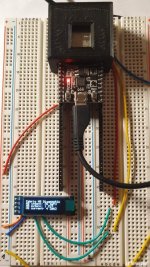
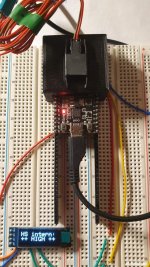
Another interesting E89 roof EKG as of today.
Continuous alerts on the dash and bongs regarding a roof issue. Unfortunately during a 400km drive.

There were no fault codes to find on OBD.
First of all:
The sensors in our Z4 roof have 2 valid states,
HIGH or
LOW, represented by
~2.0V or
~0.5V in my EKG charts. Any discrepancy indicates a (temporary or permanent) error.
EKG extract of the two microswitches coupling lock in the trunk (MS KV LI = left, MS KV RE = right):

Unusually the "jittery" signal from the left microswitch coupling lock, represented by the green line on the chart.
The voltage of about 1.28 V on the green line is completely wrong, but the signal from the right microswitch (blue line) looks perfect. Both signals seem to change their states synchronously from LOW to HIGH or vice versa.
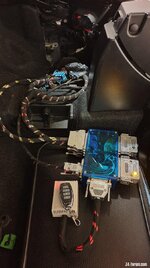
Switched between an
external attached microswitch [left red box] and
the internal microswitch of the car [right red box], the right voltage level (HIGH, LOW on the green line) deviates significantly from the norm on the left.

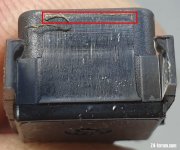
After exchanging the two MS KV with new ones, these values were measured on the old ones:
Left: 2.49 kohms - 560 ohms => 1.282V in the non-actuated state on my EKG chart
Right 2.77 kohms - 560 ohms => 0.528V in the non-actuated state on the chart
I find it interesting and irritating, that this small resistance deviation causes such a large amount of signal distortion. So far I have no explanation for these trembling fluctuations.
But anyway, as recommended in my maintenance thread, these 2 microswitches should be replaced after 10 years to avoid exactly these surprising glitches.
This Z4 was built in 2011.
 E89: Retractable Hardtop (roof) Maintenance (and additional) tasks
Edit post New: Z4 E89: Collection of the typical age-related defects in the roof environment https://z4-forum.com/threads/hourglass-done-e89-collection-of-the-9-typical-age-related-defects-in-the-roof-environment.148657/#post-2091928 Breaking News 2026 Ich habe hier im Forum einen Beitrag...

z4-forum.com



 Scottish Borders


 Attleborough, Norfolk